Christopher You

Projects

2022 – presentAI agentsAI/MLDigital health

Build-A-Being Yourself

A web-based conversational AI platform for healthcare research

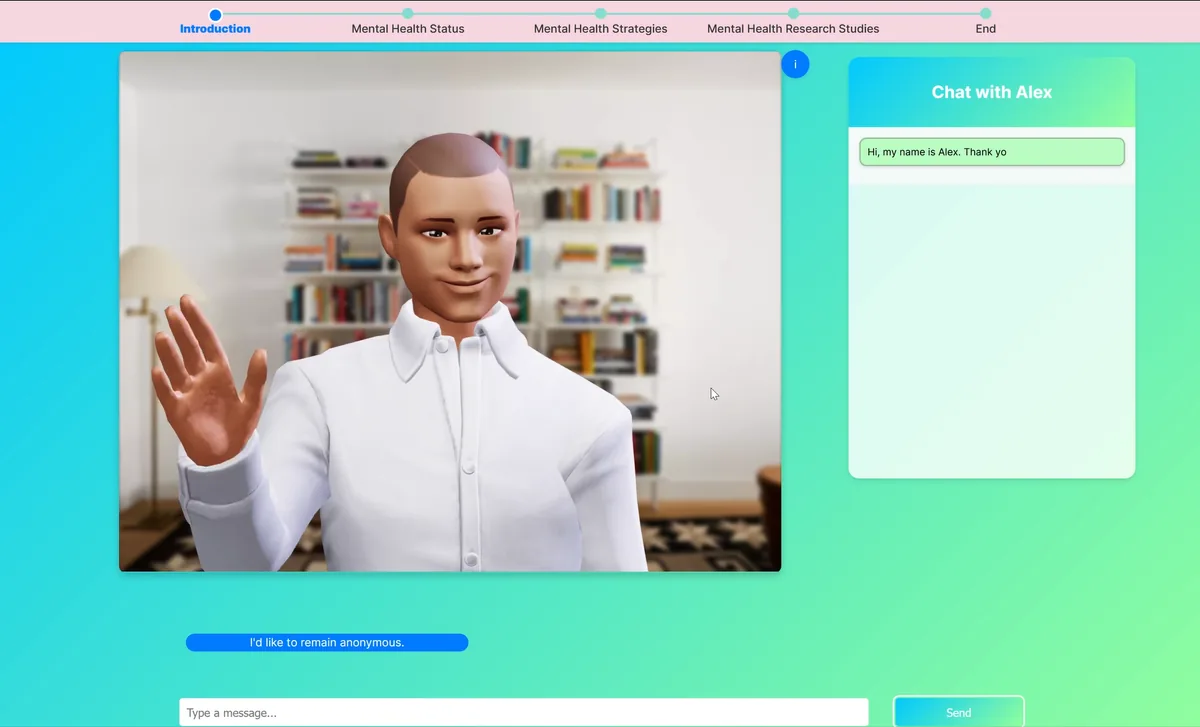
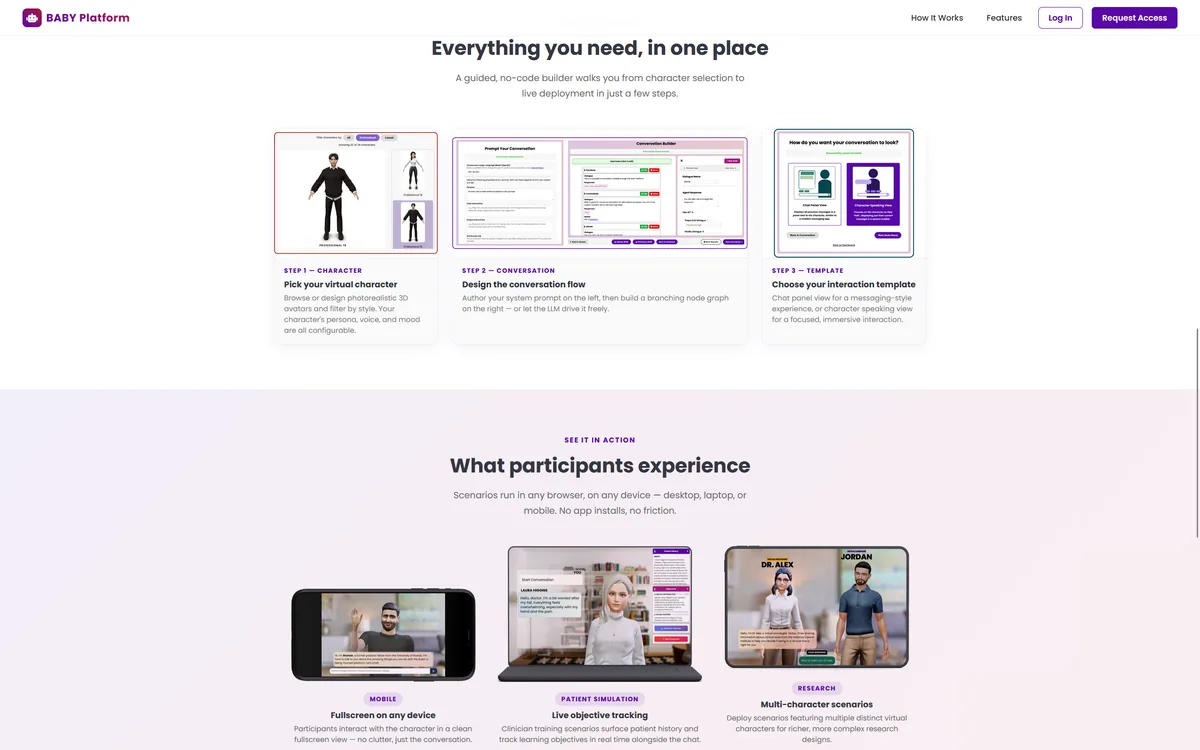
Build-A-Being Yourself (BABY) lets domain experts rapidly deploy embodied conversational interventions at scale, with no programming required. It coordinates agentic workflows across dialogue planning, strategy selection, and LLM-driven response generation. The platform has been used across NIH-funded studies in mental health, cancer clinical trial enrollment, and patient simulation for university curricula.

Built with Node.js, React, Express, AWS, OpenAI, LLMs, RAG, Python, MongoDB, REST APIs

2021 – presentAI agentsAI/MLDigital health

ALEX: Clinical trial enrollment

NIH R24 project using virtual humans to widen clinical trial participation

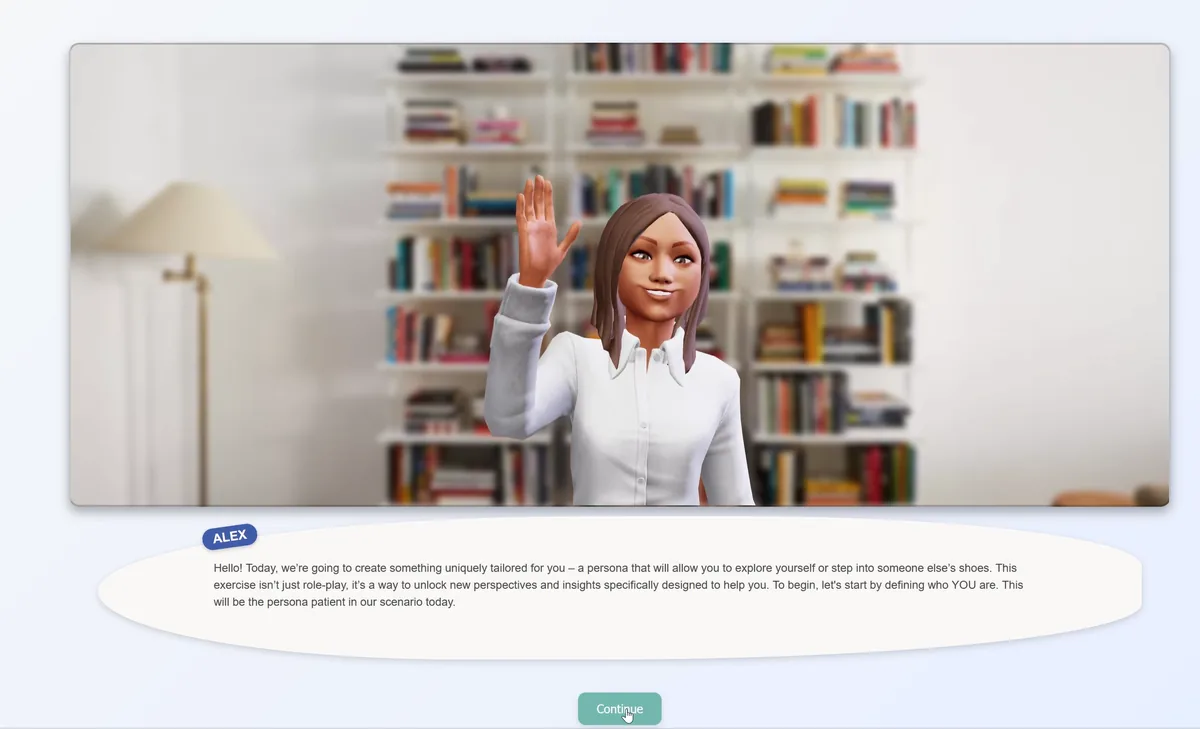
This NIH-funded project uses virtual human technology to increase clinical trial participation among older adults from minority communities (Black/African American, Hispanic/Latin, and rural adults over 50). We designed the virtual human ALEX to be culturally sensitive, tracked engagement in NIH-funded trials, and compared ALEX with standard recruitment methods. Clinical trials are queried and summarized in real time with LLM prompting and a retrieval-augmented chatbot.

Built with HTML, JavaScript, CSS, Unreal Engine, MetaHumans, machine learning models, Python, ChatGPT

2024AI agentsAI/MLDigital health

AI agents in mental health conversations

Generative-AI virtual humans for motivational interviewing

Asynchronous online mental health platforms are accessible and flexible, but they often lack the connection that keeps people engaged. This project uses generative-AI virtual humans to hold more natural, adaptive motivational interviews, and studies how they affect users' readiness for change, acceptance of mental health interventions, and trust in the therapeutic process.

Built with Node, JavaScript, CSS, AWS, OpenAI, three.js, machine learning models, Python, FastAPI

2024AI agents

Embodied interactions with AI agents

Designing guided personas to improve virtual human interaction and readiness to change

Designing guided personas that shape how users interact with a virtual human, with the goal of improving engagement and readiness to change in mental health conversations.

Built with Node, JavaScript, CSS, AWS, OpenAI, three.js, machine learning models, Python, FastAPI

2025AI/MLAI agents

Classifying motivational interviews

Fine-tuned BERT and data augmentation to classify change, sustain, and neutral talk

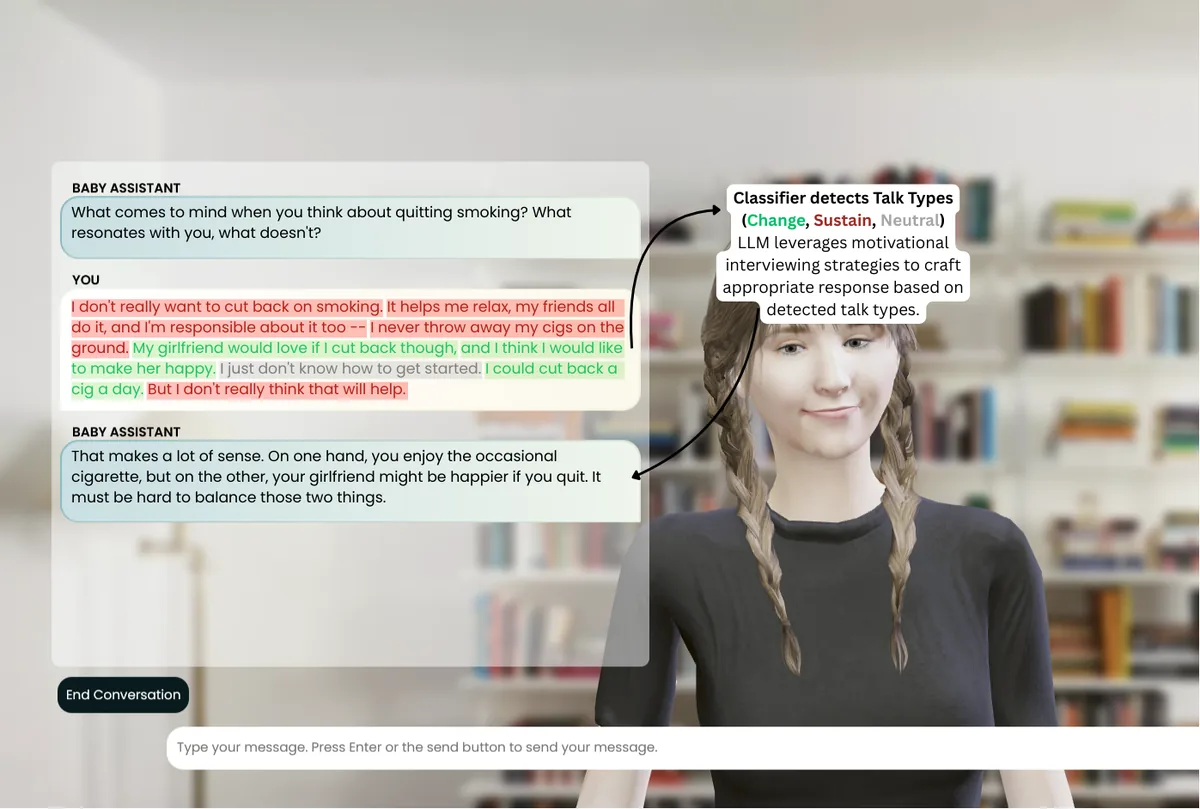
We fine-tune models to classify change talk, sustain talk, and neutral talk in motivational interviews. Users and agents can see classified utterances in real time, and LLMs use the classification to shape their responses, with the goal of improving readiness to change.

Built with Node, JavaScript, CSS, AWS, OpenAI, three.js, Python, HiPerGator, BERT, data augmentation, back-translation

2022 – 2024Virtual reality

Embodiment and agency of virtual avatars

Challenges in evaluating agency and embodiment in virtual reality

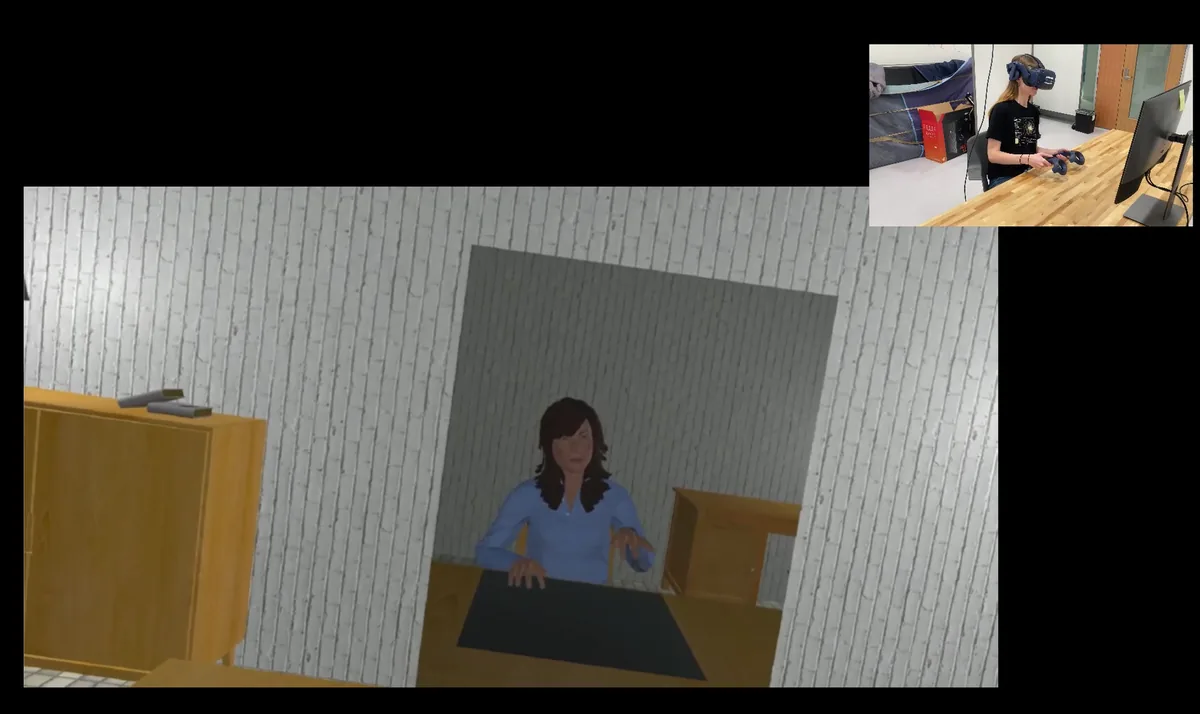
Participants controlled avatars with increasing degrees of movement (head only, head and torso, full body). More control increased embodiment, but current measures of the sense of agency proved inconsistent, pointing to better ways of measuring how control and agency interact in VR.

Built with Unity, Python

2019 – 2022Virtual reality

Redirected walking: strafing gain

Redirecting users one diagonal step at a time

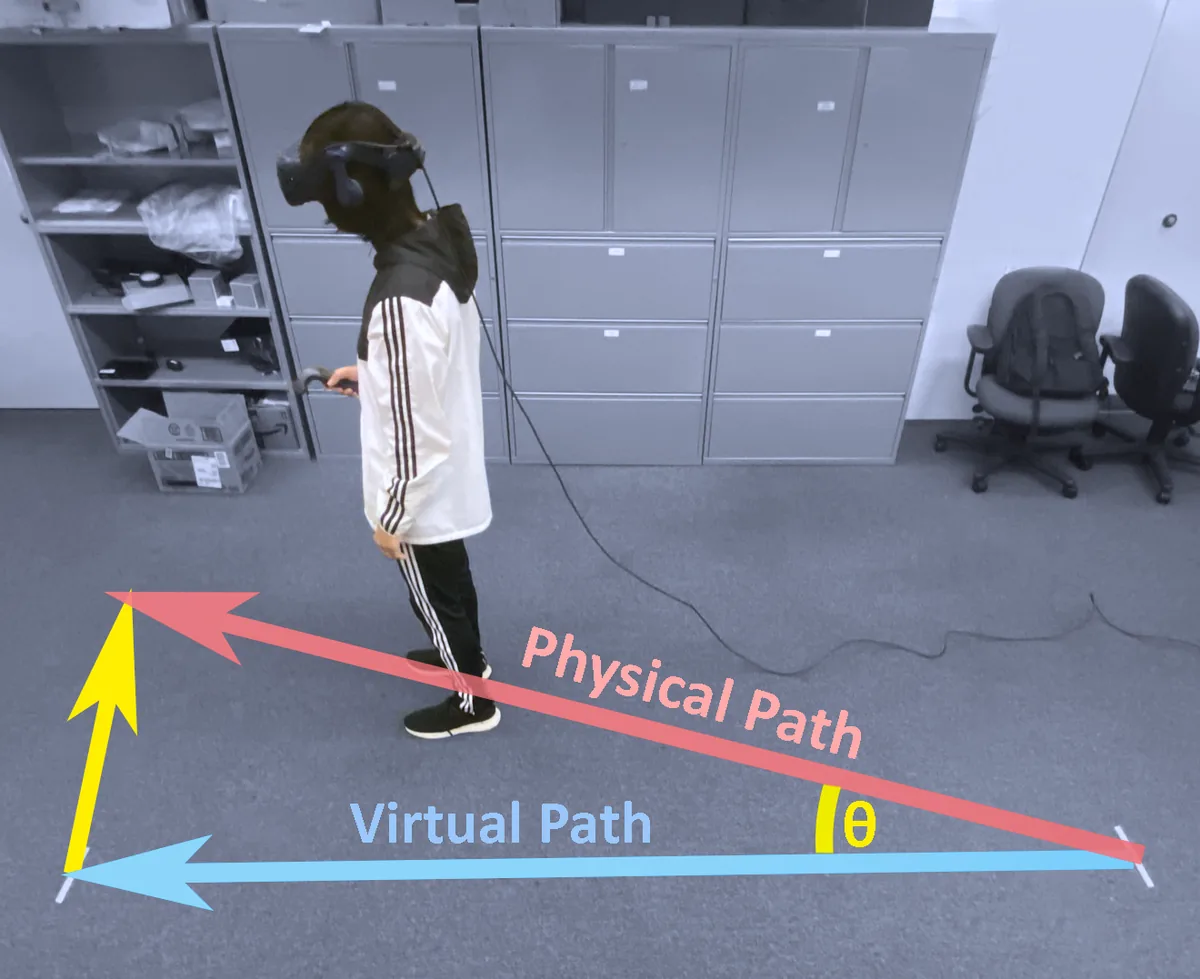
Redirected walking lets people explore virtual spaces larger than their physical room. Strafing gain adds small lateral movements so the user walks a diagonal path while keeping their original orientation. In a study with 27 participants, users could be redirected along a 5.57° diagonal to the right and 4.68° to the left without noticing; a follow-up with 10 participants confirmed orientation was maintained.

Built with Unity, C#

2020AI agentsDigital health

GET PrEPD

Goal elicitation, treatment prioritization, and electronically practiced discussion

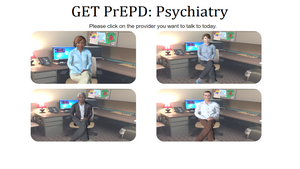
GET PrEPD advocates for the needs of patients with severe mental illnesses, using virtual humans to improve decision-making and patients' self-efficacy.

Built with Django, Inkle (dialogue management), React, Unity, Synthesia